
Blog
Tree Root Systems 101: Anatomy, Types & Functions Explained

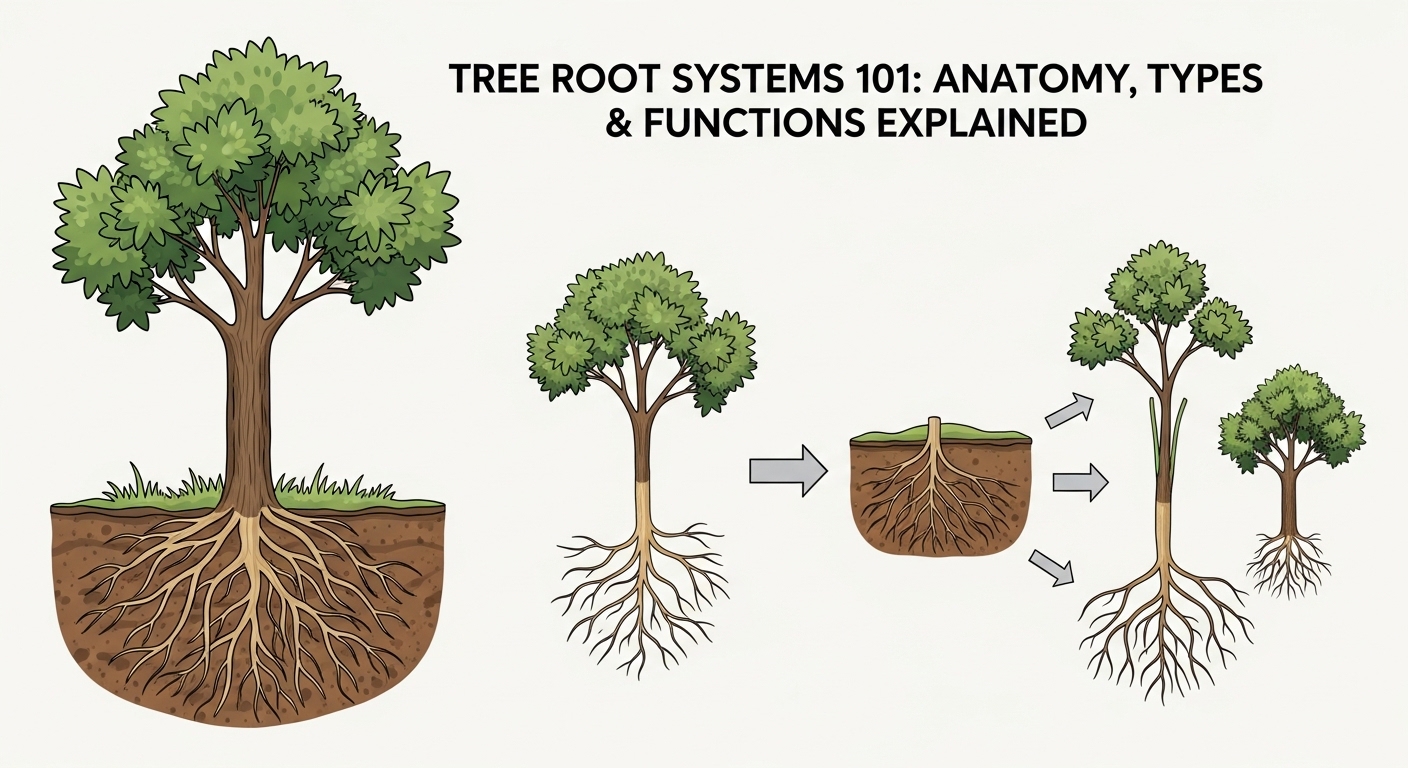
Have you ever marveled at a towering oak or a sprawling banyan tree and wondered how it remains standing through fierce storms? We often obsess over the canopy, the leaves, branches, and fruit while completely ignoring the engine room hidden beneath our feet.
It’s easy to think of roots as just “underground sticks,” but this oversimplification leads to poor gardening decisions, damaged home foundations, and unhealthy trees. Without understanding the complex architecture below the soil, you are only seeing 50% of the tree’s biology.
This guide delves deep into the underground world. We will uncover exactly what a root system is, how it functions as the lifeline of the forest, and why understanding it is critical for the health of your landscape.
What is a Tree Root System?
Definition: A tree root system is the complex underground network of organs responsible for anchoring the tree to the ground and absorbing essential water and minerals from the soil. It acts as the tree’s digestive system, structural foundation, and communication hub.
Primary Functions:
- Anchorage: Physically securing the tree against wind and gravity.
- Absorption: Taking in water and dissolved nutrients (nitrogen, phosphorus, etc.).
- Storage: Creating reserves of carbohydrates (sugar/starch) to survive winter.
- Conduction: Transporting resources up to the trunk and leaves via the xylem.
The Anatomy of a Root: How It Works
A root is not just a solid piece of wood; it is a sophisticated organ with distinct zones, each performing a specialized task.
1. The Root Cap
Think of this as the “hard hat” of the root. Located at the very tip, the root cap protects the delicate growing cells as they push through rocky, compacted soil. It also secretes a slimy lubricant (mucigel) to help the root slide through the earth more easily.
2. The Apical Meristem
Directly behind the root cap lies the zone of cell division. This is the engine of growth where new cells are constantly generated, allowing the root to lengthen and seek out new water sources.
3. Root Hairs
These are the unsung heroes of the tree. Root hairs are microscopic, hair-like extensions found just behind the growing tip. They vastly increase the surface area of the root system—sometimes by hundreds of times—acting like millions of tiny sponges that soak up moisture and minerals.
Types of Tree Root Systems
Not all roots behave the same way. Depending on the species and the environment, trees generally develop one of two primary structural systems.
1. The Taproot System
This system features one primary, dominant root that grows vertically downward. It is the “anchor” approach.
- Characteristics: Thick, central root with smaller lateral roots branching off.
- Best For: Accessing deep water tables and providing extreme stability.
- Examples: Oaks, Pines, Hickories, and Walnuts.
2. The Fibrous Root System
Instead of one main root, this system consists of a mass of thin, moderately branching roots growing from the stem.
- Characteristics: No single dominant root; forms a dense mat near the surface.
- Best For: Rapid water absorption from rainfall and preventing soil erosion.
- Examples: Maples, Birches, and most fruit trees.
Maintenance Note: Because fibrous roots form such a dense, mat-like structure, they can be notoriously difficult to extract once the tree is cut down. This is especially true if you are trying to remove palm tree stumps, which require specific techniques to handle the root ball.
3. Adventitious Roots
These are the rule-breakers. Adventitious roots arise from non-root tissue, such as stems or branches. You often see these in tropical trees like the Banyan, where “prop roots” descend from branches to support the heavy canopy.
Quick Comparison: Taproot vs. Fibrous
| Feature | Taproot System | Fibrous Root System |
| Structure | One main central root | Dense network of similar-sized roots |
| Depth | Deep penetration | Shallow and spreading |
| Stability | Excellent against the wind | Good, but prone to surface disruption |
| Drought Tolerance | High (reaches deep water) | Moderate (relies on surface water) |
The “Wood Wide Web”: The Hidden Mycorrhizal Network
Modern science has revealed that tree roots do not work alone. They engage in a symbiotic relationship with fungi known as Mycorrhizae.
This partnership creates a “biological internet” often called the Wood Wide Web.
- The Trade: The tree provides sugars (energy) to the fungi. In return, the fungi’s fine filaments extend the root system’s reach, gathering hard-to-find nutrients like phosphorus.
- Communication: Through this fungal network, trees can actually “signal” distress to their neighbors—warning them of insect attacks or drought, allowing nearby trees to ramp up their chemical defenses.
The Critical Root Zone (CRZ): A Guide for Homeowners
If you have trees on your property, understanding the Critical Root Zone (CRZ) is vital.
Most people believe tree roots mirror the canopy above (growing as deep as the tree is tall). This is a myth.
- The Reality: Most absorbing roots lie in the top 6 to 24 inches of soil.
- The Spread: Roots can extend laterally 2 to 3 times the width of the canopy (the drip line).
Pro Tip: Never park cars or pile heavy construction materials within the drip line of a tree. Compacting the soil in this zone crushes the macropores in the soil, suffocating the roots.
If you are planning renovations or digging near a large tree, it is crucial to consult a professional arborist to map this zone first. For example, specialists like AB Trees in Perth often recommend specific root mapping assessments to prevent accidental damage to your property’s foundation or the tree’s health.
Conclusion
The root system is far more than just a structural anchor; it is a dynamic, sensing, and communicating entity that dictates the survival of the forest. From the microscopic root hairs scavenging for drops of water to the vast mycorrhizal networks connecting entire ecosystems, the activity underground is as complex as the life above it.
The next time you walk past a massive tree, ask yourself: If you could see the hidden half of that organism, would you treat the ground around it differently?

In a world where digital transformation is no longer optional but essential, emerging concepts often redefine how startups, entrepreneurs, and tech professionals think about growth. Leonaarei is one such rising idea—an evolving framework that blends creativity, strategy, and technology into a cohesive approach for modern innovation. While still gaining traction, leonaarei is quickly becoming a term associated with forward-thinking digital ecosystems and adaptive business models.
For founders navigating competitive markets or professionals striving to stay ahead of trends, understanding leonaarei is not just useful it’s becoming necessary.
What Is Leonaarei?
At its core, leonaarei represents a hybrid approach to digital development that integrates user-centric design, agile execution, and scalable technology infrastructure. It is less about a single tool or platform and more about a mindset—one that encourages flexibility, experimentation, and continuous evolution.
Unlike traditional frameworks that often rely on rigid processes, leonaarei thrives on adaptability. It allows businesses to respond to market shifts in real time while maintaining a strong focus on user experience and value creation.
The concept draws inspiration from modern startup culture, where speed, innovation, and customer feedback drive success. By aligning technical capabilities with business goals, leonaarei bridges the gap between vision and execution.
Why Leonaarei Matters in Today’s Digital Economy
The digital economy is defined by rapid change. Technologies evolve, customer expectations shift, and competition intensifies almost overnight. In this environment, static strategies quickly become obsolete.
Leonaarei offers a solution by emphasizing:
- Continuous iteration over one-time perfection
- Data-driven decision-making instead of guesswork
- Seamless integration of tools and systems
- Collaboration across teams and disciplines
For startups, this means faster product launches and improved market fit. For established companies, it provides a pathway to modernize operations without disrupting core business functions.
The Core Principles of Leonaarei
To fully understand leonaarei, it’s helpful to explore its foundational principles. These guiding ideas shape how organizations implement the concept in real-world scenarios.
1. User-Centric Innovation
Leonaarei places the user at the center of every decision. Whether designing a product, developing software, or creating a marketing campaign, the focus remains on delivering meaningful experiences.
This approach ensures that solutions are not only technically sound but also relevant and valuable to the end user.
2. Agile and Iterative Development
Speed is critical in today’s market, but so is adaptability. Leonaarei encourages teams to work in short cycles, testing ideas quickly and refining them based on feedback.
This iterative process reduces risk and increases the likelihood of success.
3. Scalable Technology Integration
A key aspect of leonaarei is building systems that can grow with the business. Instead of investing in rigid infrastructures, organizations adopt flexible technologies that support expansion and innovation.
4. Data-Driven Strategy
Decisions in leonaarei are guided by data. Analytics, user insights, and performance metrics play a central role in shaping strategies and measuring success.
5. Cross-Functional Collaboration
Leonaarei breaks down silos within organizations. It encourages collaboration between developers, designers, marketers, and business leaders to create cohesive solutions.
Real-World Applications of Leonaarei
The versatility of leonaarei makes it applicable across industries. From tech startups to enterprise organizations, its principles can be adapted to various contexts.
Startups and Product Development
For startups, leonaarei provides a framework for building and launching products بسرعة and efficiently. By focusing on minimum viable products (MVPs) and continuous improvement, founders can validate ideas without excessive risk.
Digital Marketing Strategies
In marketing, leonaarei helps teams create campaigns that are both creative and data-driven. By analyzing user behavior and engagement metrics, marketers can optimize their strategies in real time.
Software Engineering
Developers benefit from leonaarei’s emphasis on modular design and agile workflows. This approach enables faster development cycles and easier maintenance.
Business Operations
Leonaarei also impacts internal operations by promoting automation, efficiency, and scalability. Organizations can streamline processes while maintaining flexibility.
Leonaarei vs Traditional Frameworks
To better understand the value of leonaarei, it’s useful to compare it with traditional approaches.
| Aspect | Traditional Frameworks | Leonaarei Approach |
|---|---|---|
| Development Style | Linear and rigid | Agile and iterative |
| User Focus | Often secondary | Central priority |
| Decision-Making | Experience-based | Data-driven |
| Scalability | Limited flexibility | Highly scalable |
| Collaboration | Departmental silos | Cross-functional teamwork |
| Adaptability | Slow to change | Rapid and responsive |
This comparison highlights why many organizations are shifting toward more dynamic models like leonaarei.
How to Implement Leonaarei in Your Business
Adopting leonaarei does not require a complete overhaul of your existing systems. Instead, it involves gradual changes in mindset, processes, and tools.
Start with a Clear Vision
Define what you want to achieve and how leonaarei aligns with your business goals. This clarity will guide your implementation strategy.
Embrace Agile Methodologies
Introduce agile practices such as sprint planning, regular feedback loops, and iterative development. These elements are essential to the leonaarei approach.
Invest in the Right Tools
Choose technologies that support scalability and integration. Cloud platforms, analytics tools, and collaboration software are key components.
Foster a Collaborative Culture
Encourage communication and teamwork across departments. Leonaarei thrives in environments where ideas flow freely.
Use Data to Drive Decisions
Implement systems for tracking performance and analyzing user behavior. Use this data to refine your strategies continuously.
Challenges and Considerations
While leonaarei offers numerous benefits, it is not without challenges.
Organizations may face resistance to change, especially when transitioning from traditional models. Additionally, implementing new tools and processes requires time and resources.
Another challenge is maintaining balance. While agility is important, it should not come at the expense of long-term planning and stability.
To overcome these challenges, businesses must approach leonaarei with a clear strategy and strong leadership.
The Future of Leonaarei
As digital transformation continues to accelerate, concepts like leonaarei are likely to play an increasingly important role. The demand for flexible, scalable, and user-focused solutions is only growing.
In the future, we can expect leonaarei to evolve further, incorporating emerging technologies such as artificial intelligence, automation, and advanced analytics.
For entrepreneurs and tech professionals, staying ahead of these trends will be critical. Those who embrace innovative frameworks like leonaarei will be better positioned to succeed in a rapidly changing landscape.
Why Entrepreneurs Should Pay Attention to Leonaarei
Entrepreneurs operate in environments where uncertainty is the norm. Leonaarei provides a structured yet flexible approach to navigating this uncertainty.
By focusing on user needs, leveraging data, and embracing continuous improvement, founders can build businesses that are both resilient and innovative.
Moreover, leonaarei encourages experimentation—a key driver of breakthrough ideas. It allows entrepreneurs to test concepts quickly and pivot when necessary.
Conclusion: Is Leonaarei the Future of Digital Innovation?
Leonaarei is more than just a buzzword—it represents a shift in how we approach digital transformation. By combining agility, user-centric design, and data-driven strategies, it offers a powerful framework for modern businesses.
For startups, it provides a pathway to rapid growth and innovation. For established organizations, it offers a way to stay competitive in an ever-evolving market.
As the digital landscape continues to change, embracing concepts like leonaarei may not just be an advantage—it could become a necessity.

In today’s fast-moving digital economy, businesses are constantly searching for smarter ways to streamline operations, improve collaboration, and scale efficiently. This is where wollwirrware enters the conversation. As organizations struggle with fragmented tools, disconnected workflows, and growing complexity, wollwirrware presents a fresh, integrated approach that aligns technology with real-world business needs.
At its core, wollwirrware is more than just a concept it represents a shift in how startups, entrepreneurs, and tech professionals think about digital infrastructure. Instead of relying on scattered systems, wollwirrware emphasizes cohesion, adaptability, and intelligent workflow design.
What Is Wollwirrware?
Wollwirrware can be understood as a modern framework or ecosystem that unifies digital tools, processes, and data into a seamless operational environment. It blends automation, collaboration platforms, and data-driven decision-making into one cohesive structure.
Unlike traditional software systems that often operate in silos, wollwirrware is designed to eliminate friction. It connects teams, tools, and tasks in a way that enhances productivity without adding unnecessary complexity.
For startups, this means faster execution. For enterprises, it means better scalability. And for tech professionals, it offers a more intuitive way to build and manage systems.
The Growing Need for Wollwirrware
The demand for wollwirrware is driven by a simple reality: modern businesses are overwhelmed by tools. From project management apps to communication platforms and analytics dashboards, the average company uses dozens of systems daily.
This creates several challenges:
- Data fragmentation
- Inefficient workflows
- Communication gaps
- Increased operational costs
Wollwirrware addresses these challenges by creating a unified environment where everything works together. Instead of switching between platforms, teams can operate within a connected ecosystem.
Key Features of Wollwirrware
One of the defining aspects of wollwirrware is its ability to integrate multiple functionalities into a single framework. It is not just about combining tools—it’s about making them work intelligently together.
Seamless Integration
Wollwirrware connects different software systems, allowing data to flow freely across platforms. This eliminates duplication and ensures consistency.
Automation-Driven Workflows
Automation is at the heart of wollwirrware. Routine tasks can be handled automatically, freeing up time for strategic work.
Real-Time Collaboration
Teams can collaborate in real time without relying on multiple communication channels. This improves transparency and speeds up decision-making.
Scalability
As businesses grow, wollwirrware adapts. It supports expansion without requiring a complete overhaul of existing systems.
Data-Centric Approach
Wollwirrware leverages data to provide actionable insights. This helps organizations make informed decisions quickly.
How Wollwirrware Works in Practice
To understand the practical value of wollwirrware, consider a startup managing product development. Traditionally, the team might use separate tools for task management, communication, design, and analytics.
With wollwirrware, these functions are interconnected. When a task is updated, the entire system reflects the change. Notifications are triggered automatically, and data is updated in real time.
This interconnected approach reduces delays, minimizes errors, and improves overall efficiency.
Wollwirrware vs Traditional Systems
The difference between wollwirrware and traditional systems becomes clear when you compare their core characteristics.
| Feature | Traditional Systems | Wollwirrware Approach |
|---|---|---|
| Tool Integration | Limited or manual | Fully integrated |
| Workflow Efficiency | Fragmented | Streamlined |
| Data Accessibility | Scattered | Centralized |
| Scalability | Complex upgrades | Flexible and adaptive |
| Collaboration | Disconnected | Real-time and unified |
This comparison highlights why more businesses are exploring wollwirrware as a solution for modern challenges.
Benefits of Adopting Wollwirrware
The adoption of wollwirrware brings tangible benefits across different aspects of a business.
Improved Productivity
By reducing the need to switch between tools, teams can focus on meaningful work. Automation further enhances productivity by handling repetitive tasks.
Better Decision-Making
With centralized data and real-time insights, leaders can make informed decisions quickly. This is especially critical in fast-paced industries.
Cost Efficiency
Wollwirrware reduces the need for multiple subscriptions and minimizes operational inefficiencies, leading to cost savings.
Enhanced Collaboration
Teams can work together more effectively when all tools and data are accessible within a single ecosystem.
Faster Time-to-Market
For startups, speed is everything. Wollwirrware enables quicker execution, helping businesses launch products faster.
Wollwirrware for Startups
Startups operate in high-pressure environments where agility is crucial. Wollwirrware provides a foundation that supports rapid growth without compromising efficiency.
By adopting wollwirrware early, startups can:
- Avoid the pitfalls of fragmented systems
- Build scalable processes from day one
- Improve team coordination
- Accelerate innovation
This makes wollwirrware an attractive option for founders looking to establish a strong operational backbone.
Wollwirrware in Enterprise Environments
While startups benefit from agility, enterprises require stability and scalability. Wollwirrware addresses both needs.
Large organizations often struggle with legacy systems and complex workflows. Wollwirrware simplifies these challenges by integrating existing tools and optimizing processes.
This leads to:
- Reduced operational complexity
- Improved cross-department collaboration
- Better data management
- Enhanced organizational agility
Challenges and Considerations
Despite its advantages, implementing wollwirrware is not without challenges.
Integration Complexity
Connecting existing systems can be technically demanding. Businesses need a clear strategy to ensure smooth integration.
Change Management
Adopting wollwirrware requires a cultural shift. Teams must be willing to embrace new workflows and tools.
Initial Investment
While wollwirrware can reduce costs in the long run, the initial setup may require investment in technology and training.
Security Concerns
With centralized data, security becomes a critical consideration. Businesses must ensure robust protection measures are in place.
Best Practices for Implementing Wollwirrware
To successfully adopt organizations should follow a strategic approach.
Start by assessing current workflows and identifying inefficiencies. This helps in understanding where wollwirrware can add value. Next, choose tools and platforms that align with business goals. Integration should be planned carefully to avoid disruptions.
Training is equally important. Teams must understand how to use the new system effectively. Finally, continuously monitor and optimize workflows. Wollwirrware is not a one-time solution it evolves with the business.
The Future of Wollwirrware
As technology continues to evolve, It is expected to play a significant role in shaping the future of work.
Emerging trends such as artificial intelligence, machine learning, and advanced analytics will further enhance its capabilities. These technologies will enable more intelligent automation and deeper insights. In the coming years, wollwirrware could become a standard approach for managing digital operations, especially as businesses prioritize efficiency and scalability.
Why Wollwirrware Matters Now
The importance of lies in its ability to address real-world challenges. In an era where time, efficiency, and adaptability are critical, businesses cannot afford to rely on outdated systems. Wollwirrware offers a practical solution that aligns with modern demands. It bridges the gap between technology and business operations, creating a more cohesive and efficient environment.
For entrepreneurs and tech professionals, understanding wollwirrware is not just beneficial it’s essential.
Conclusion
its represents a new way of thinking about digital workflows. By integrating tools, automating processes, and centralizing data, it enables businesses to operate more efficiently and effectively. Whether you are a startup founder looking to scale quickly or an enterprise leader aiming to optimize operations, provides a framework that adapts to your needs.
As the digital landscape continues to evolve, adopting innovative approaches like will be key to staying competitive. It is not just a trend it is a strategic advantage that can redefine how businesses function in the modern world.

-
 Blog4 months ago
What Is i̇ns? Exploring Its Origins, Usage, and Symbolism
-
 Blog1 year ago
Jememôtre: A Hidden Gem in the World of Culture
-

 Technology3 months ago
100GBASE-ZR4 Optical Modules: A Practical Long-Reach Solution for Modern Data Center Interconnects
-

 Business3 months ago
Essential Online Banking Security Tips to Protect Your Finances
-

 Technology4 months ago
Cartetach: The Next Big Thing in Digital Communication
-

 Technology4 months ago
Rgarrpto: Understanding Its Impact on Modern Technology
-

 Life Style4 months ago
Taylor Breesey Face Reveal: Everything Fans Need to Know
-

 Blog4 months ago
Daniel R Locke Virtual AIA: A Complete Profile and Career Overview